

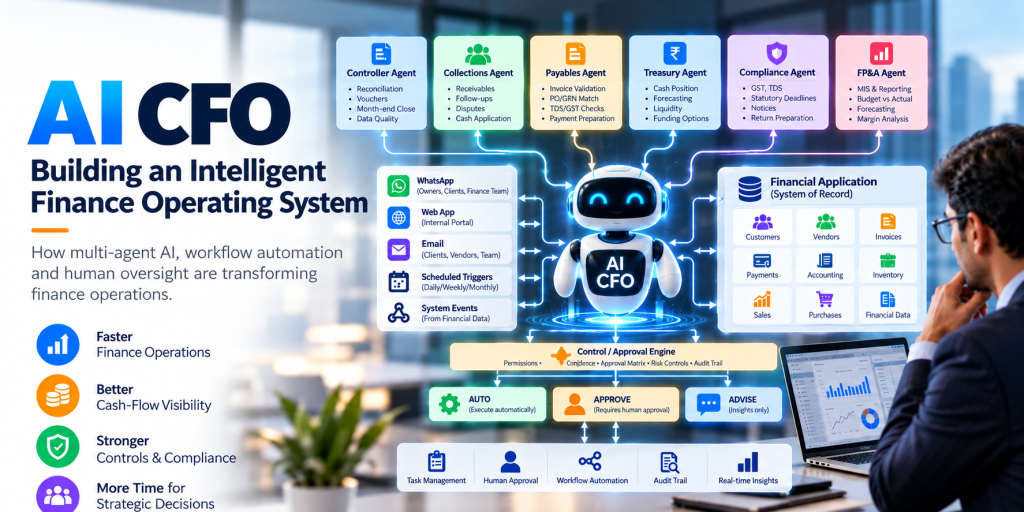
How a multi-agent AI architecture can automate finance operations while keeping humans in control of critical financial decisions
Finance teams are under increasing pressure to deliver faster reporting, better cash-flow visibility, tighter controls, and quicker responses to business stakeholders.
Yet much of the finance function still depends on repetitive activities such as reconciliation, invoice validation, collections follow-ups, payment preparation, compliance monitoring, reporting, and manually coordinating approvals.
ProfitNiti’s AI CFO architecture addresses this challenge by introducing an intelligent AI layer on top of the existing ProfitNiti financial platform.
The architecture combines n8n workflows, specialized AI finance agents, ProfitNiti APIs, task management, approval controls, human oversight, and automated execution into a single operating model.
The objective is not to replace the finance team.
It is to allow AI to handle repetitive analysis and preparation while finance professionals retain control over important financial decisions.
The Business Challenge
Traditional finance systems are effective at storing and processing financial information. However, finance teams often spend considerable time converting that information into actions.
A typical process can look like this:
Request → Find data → Analyse → Prepare response → Obtain approval → Execute → Update records → Follow up
When these steps are handled manually, several challenges emerge.
Common Finance Operations Challenges
- Finance data is spread across multiple modules and systems.
- Reconciliation requires significant manual effort.
- Customer collections depend on repeated follow-ups.
- Invoice and purchase-order validation can be time-consuming.
- Cash-flow information may require manual consolidation.
- Compliance deadlines depend heavily on reminders and human tracking.
- Management reports often require manual preparation.
- Email and messaging conversations can become disconnected from financial tasks.
- Approvals can create bottlenecks.
- It can be difficult to determine who owns an outstanding action.
- Senior finance professionals spend time answering repetitive operational questions.
The fundamental challenge is therefore not simply access to financial data.
The challenge is turning financial data into timely, controlled action.
The ProfitNiti AI CFO Approach
ProfitNiti introduces an AI CFO layer between users, finance workflows, and the existing financial application.
At the center of the architecture is the CFO Agent, which acts as the orchestrator for finance-related AI activities.
The CFO Agent can:
- Understand a request or financial event.
- Retrieve relevant business information.
- Determine the required workflow.
- Delegate work to specialized finance agents.
- Combine the results.
- Generate recommendations.
- Determine whether an action should be automated or approved.
- Create and assign tasks.
- Execute approved actions through connected APIs.
- Verify the outcome.
- Update ProfitNiti.
- Initiate follow-up actions.
- Maintain an audit trail.
This creates a closed-loop finance workflow:
Understand → Plan → Delegate → Analyse → Approve → Execute → Verify → Update → Follow Up
The AI CFO Architecture
The architecture consists of several interconnected layers.
1. Users and Business Channels
The AI CFO can receive requests and events from multiple channels, including:
- ProfitNiti Web Application
- Scheduled triggers
- System events
This means finance automation does not have to begin from a single interface.
For example, a finance manager could ask:
“Which customers have overdue invoices above ₹10 lakh?”
Alternatively, a scheduled workflow could automatically trigger:
“Review overdue receivables every morning and prepare follow-up actions.”
The same AI CFO infrastructure can handle both scenarios.
2. CFO Agent — The Orchestrator
The CFO Agent acts as the central intelligence and coordination layer.
Its role is not to perform every finance activity itself.
Instead, it determines which specialist agent should perform which part of the work.
CFO Agent Responsibilities
Understand
Interpret the request, event, financial context, and expected outcome.
Plan
Determine which information and workflows are required.
Delegate
Assign activities to specialized finance agents.
Decide
Determine whether the result can be automated, requires approval, or should remain advisory.
Coordinate
Combine the results from multiple agents.
Follow Up
Create tasks and monitor outstanding actions.
This creates a multi-agent model rather than a single general-purpose finance chatbot.
3. Specialized Finance AI Agents
The architecture includes specialized agents for key finance functions.
| AI Agent | Primary Responsibilities |
|---|---|
| Controller Agent | Data synchronization, reconciliation, vouchers, month-end close, data quality |
| Collections Agent | Receivables, customer follow-ups, disputes, cash application |
| Payables Agent | Invoice validation, PO/GRN matching, GST/TDS checks, payment preparation |
| Treasury Agent | Cash position, cash forecasting, liquidity and funding analysis |
| Compliance Agent | GST, TDS, statutory deadlines, notices and compliance activities |
| FP&A Agent | MIS, budgeting, forecasting, variance analysis, margin and cost analysis |
This specialization allows each agent to operate within a clearly defined financial responsibility.
4. ProfitNiti Remains the System of Record
A key principle of the architecture is that the AI layer does not replace the existing ProfitNiti application.
ProfitNiti remains the single source of truth.
The AI CFO interacts with the Laravel application through secure APIs.
Information Available to the AI Layer
The AI CFO can retrieve relevant information such as:
- Companies
- Users
- Customers
- Vendors
- Invoices
- Payments
- Bank information
- Accounting data
- Inventory
- Sales
- Purchases
- Financial documents
- Existing tasks
Information Written Back
After processing, the AI layer can update ProfitNiti with:
- Tasks
- Workflow status
- Recommendations
- Results
- Updates
- Logs
- Follow-up actions
This separation is important.
The AI layer provides intelligence and orchestration, while ProfitNiti remains responsible for the underlying financial records and business data.
5. Human-in-the-Loop Finance Automation
Financial automation cannot be treated the same way as ordinary workflow automation.
A finance AI system needs clear controls around permissions, approvals, risk, and accountability.
ProfitNiti therefore introduces a Control / Approval Engine between AI recommendations and execution.
The control layer incorporates:
- Permissions
- Confidence thresholds
- Approval matrices
- Maker-checker controls
- Risk controls
- Audit trails
The architecture supports three execution modes.
AUTO
The AI can execute predefined, low-risk activities automatically.
Examples include:
- Generating internal reports
- Creating reminders
- Preparing routine analysis
- Creating internal tasks
- Performing predefined reconciliation activities
APPROVE
The AI prepares the action, but a human must approve it.
Examples include:
- Payment proposals
- Customer communications
- Vendor communications
- Journal entries
- Credit recommendations
- Payment execution
ADVISE
The AI provides analysis or recommendations, but a human makes and executes the final decision.
Examples include:
- Funding decisions
- Strategic recommendations
- Major business decisions
- High-risk external actions
This creates a practical model for controlled AI adoption in finance.
6. AI vs Human Responsibility Matrix
The following matrix illustrates how responsibility can be distributed between AI and finance professionals.
| Finance Activity | AI Analysis | AI Preparation | AI Execution | Human Approval | Human Decision |
|---|---|---|---|---|---|
| Financial reporting | ✓ | ✓ | ✓ | — | — |
| Bank reconciliation | ✓ | ✓ | ✓* | — | — |
| Customer reminders | ✓ | ✓ | ✓* | Optional | — |
| Payment proposal | ✓ | ✓ | — | ✓ | ✓ |
| Payment execution | ✓ | ✓ | — | ✓ | ✓ |
| Vendor communication | ✓ | ✓ | — | ✓ | — |
| Customer dispute | ✓ | ✓ | — | ✓ | ✓ |
| Cash-flow forecast | ✓ | ✓ | ✓ | — | ✓ |
| Funding recommendation | ✓ | ✓ | — | — | ✓ |
| Journal entry | ✓ | ✓ | — | ✓ | ✓ |
| Compliance monitoring | ✓ | ✓ | ✓* | — | — |
| Strategic financial decision | ✓ | ✓ | — | — | ✓ |
*Subject to predefined rules, permissions, and confidence thresholds.
The objective is not maximum automation.
The objective is appropriate automation with appropriate control.
7. Task-Centric Finance Operations
One of the most important aspects of the architecture is that AI activity is connected to the ProfitNiti Task Module.
Every request or action can become a structured task.
AI Agent Tasks
Examples include:
- Data analysis
- Drafting communications
- Reconciliation
- Report generation
- Preparing payment files
- Follow-up reminders
- Monitoring deadlines
Human Tasks
Examples include:
- Reviewing and approving payments
- Reviewing vouchers
- Handling customer disputes
- Providing documents
- Reviewing financial recommendations
- Executing external business decisions
Mixed Tasks
In mixed workflows, AI prepares the work while a human approves the final action.
For example:
AI analyses invoices → AI prepares payment proposal → Finance manager approves → System executes → AI verifies
This creates a clear chain of responsibility.
8. Finance Automation Matrix
A practical implementation can classify finance processes according to their automation potential.
| Finance Function | AI Opportunity | Automation Potential | Human Control |
|---|---|---|---|
| Reconciliation | Matching and exception detection | High | Exception review |
| Collections | Customer prioritization and follow-up preparation | High | Escalations |
| Payables | Invoice and PO validation | High | Payment approval |
| Treasury | Cash-flow forecasting | Medium | Funding decisions |
| Compliance | Deadline monitoring and preparation | High | Regulatory decisions |
| FP&A | MIS, variance and forecasting | High | Business interpretation |
| Management Reporting | Automated reporting | High | Management review |
| Communications | Drafting and workflow routing | Medium–High | External approval |
| Task Management | Automatic task creation | High | Ownership |
| Audit Trail | Automatic activity logging | High | Audit review |
This matrix can also serve as the starting point for an AI automation roadmap.
9. Example: AI-Powered Collections Workflow
Consider a CFO asking:
“Show me customers with overdue invoices above ₹10 lakh and prepare follow-up actions.”
The AI CFO can turn this request into an end-to-end workflow.
Step 1 — Understand the Request
The CFO Agent interprets the amount threshold and identifies that the request relates to receivables.
Step 2 — Retrieve Financial Context
ProfitNiti provides:
- Customer information
- Outstanding invoices
- Due dates
- Payment history
- Previous follow-ups
- Dispute information
Step 3 — Collections Agent Analysis
The Collections Agent analyses the receivables and identifies:
- Overdue customers
- Ageing
- Outstanding amounts
- Payment history
- Disputes
- Follow-up priority
Step 4 — Prepare Recommendations
The system prepares:
- Customer priority
- Amount outstanding
- Ageing
- Recommended action
- Suggested communication
- Follow-up date
Step 5 — Apply Approval Rules
The Control Engine determines whether the communication can be sent automatically or requires human approval.
Step 6 — Create Tasks
ProfitNiti creates the relevant tasks and assigns ownership.
Step 7 — Execute Approved Communication
The approved communication is sent through the configured channel.
Step 8 — Verify and Follow Up
The AI monitors the outcome and creates the next task if the expected response or payment does not occur.
The result is more than an automated answer.
It is a continuous finance workflow.
10. Before and After
| Traditional Finance Operations | ProfitNiti AI CFO |
|---|---|
| Users search multiple systems | AI retrieves relevant context |
| Finance teams manually analyse data | Specialist AI agents analyse data |
| Requests handled individually | Requests become structured tasks |
| Manual follow-ups | Automated follow-up workflows |
| Approvals handled separately | Central approval engine |
| Reports prepared manually | AI-assisted reporting |
| Humans perform repetitive preparation | AI prepares first drafts |
| Execution is disconnected | Execution linked to ProfitNiti |
| Fragmented task visibility | Centralized task management |
| Limited action traceability | AI and human actions logged |
| Reactive workflows | Event- and schedule-driven workflows |
| Finance staff spend time collecting information | Finance staff can focus more on analysis and decisions |
11. Illustrative Results and Business Impact
The architecture provides a framework for measuring the impact of AI automation across finance operations.
Because actual production KPI data is not part of the architecture specification, the numbers below should be treated as illustrative target outcomes, not historical results.
Illustrative Target Outcomes
| KPI | Illustrative Target |
|---|---|
| Reduction in repetitive finance task effort | 40–60% |
| Reduction in manual report preparation effort | 60–80% |
| Reduction in invoice validation effort | 50–70% |
| Reduction in collections follow-up preparation | 60–75% |
| Management reporting turnaround | Same day |
| Compliance monitoring | Continuous |
| AI and human task tracking | Centralized |
| Auditability of AI actions | End-to-end |
| Financially sensitive actions | Human approval controlled |
These targets should be replaced with measured implementation results once sufficient production data becomes available.
12. AI CFO KPI Matrix
For a production implementation, the following KPIs can be tracked.
| Category | KPI | Measurement |
|---|---|---|
| Productivity | Finance hours saved | Before vs. after automation |
| Productivity | Automation rate | Automated tasks / eligible tasks |
| Collections | DSO | Days Sales Outstanding |
| Collections | Overdue receivables | ₹ overdue |
| Payables | Invoice processing time | Receipt to validation |
| Reconciliation | Reconciliation cycle time | Start to completion |
| Treasury | Forecast accuracy | Forecast vs. actual |
| Compliance | Missed deadlines | Number of missed deadlines |
| FP&A | Reporting turnaround | Period close to report |
| AI | Approval rate | Recommendations approved / submitted |
| AI | Exception rate | Exceptions / processed transactions |
| Governance | Audit coverage | Actions with complete audit trail |
| User Experience | Response time | Request to response |
| Task Management | SLA adherence | Tasks completed within SLA |
These metrics turn the AI CFO from an AI initiative into a measurable finance transformation program.
13. Governance and Risk-Control Matrix
AI adoption in finance requires strong governance.
| Control | Purpose | Example |
|---|---|---|
| Role-based permissions | Restrict access | Agents access only authorized data |
| Company-level isolation | Protect business data | Company data remains separated |
| Approval matrix | Control financial actions | Payments require designated approval |
| Confidence threshold | Reduce unreliable automation | Low-confidence cases go to humans |
| Maker-checker | Separate preparation and approval | AI prepares, human approves |
| Audit trail | Trace activities | Request → decision → execution |
| Task ownership | Establish accountability | Every task assigned to AI or human |
| Communication approval | Control external messaging | Approved templates and workflows |
| API authentication | Secure system access | Controlled API credentials |
| Result verification | Confirm execution | AI verifies the outcome |
This control framework is critical to moving from experimental AI to enterprise finance automation.
14. Business Impact
The most significant opportunity is not simply automating individual finance tasks.
It is creating a closed-loop finance operating model.
Traditional Model
Data → Human Analysis → Human Action → Manual Follow-up
AI CFO Model
Data → AI Analysis → Recommendation → Approval → Execution → Verification → Follow-up
This can allow finance professionals to spend less time on repetitive coordination and more time on:
- Financial analysis
- Business partnering
- Risk management
- Cash-flow strategy
- Performance management
- Strategic decision-making
The AI CFO therefore acts as a digital finance workforce working alongside the human finance team.
15. From Finance Software to Finance Intelligence
The architecture represents a shift from traditional financial software toward an intelligent finance operating model.
Traditional software primarily answers:
“What happened?”
An AI-enabled finance platform can move toward:
“What happened, why did it happen, what should we do next, and who should do it?”
The difference is significant.
The AI CFO can connect financial information with workflows, recommendations, tasks, approvals, execution, and follow-up.
That creates a system capable of moving from information to action.
16. A Practical AI CFO Maturity Model
Organizations do not need to automate everything at once.
The ProfitNiti architecture supports a gradual maturity path.
Stage 1 — Assist
AI answers questions and provides financial analysis.
Stage 2 — Prepare
AI prepares reports, communications, reconciliations, recommendations, and tasks.
Stage 3 — Approve
AI prepares actions while humans review and approve financially sensitive activities.
Stage 4 — Automate
Low-risk, predefined activities are executed automatically.
Stage 5 — Optimize
The system continuously identifies opportunities for additional automation and process improvement.
This approach allows organizations to increase automation while maintaining appropriate financial controls.
17. The Strategic Value of the Architecture
The strength of the ProfitNiti AI CFO model comes from combining several technologies and operating principles:
Existing Financial Platform
ProfitNiti remains the source of truth.
AI Orchestration
The CFO Agent coordinates finance activities.
Specialized AI Agents
Each finance function receives focused intelligence.
Workflow Automation
n8n connects events, agents, applications, and actions.
Human Oversight
Approvals remain part of financially sensitive workflows.
Task Management
AI and human work are tracked through a common task system.
Auditability
Actions, approvals, results, and follow-ups can be recorded.
Together, these components create an architecture that is much more than a finance chatbot.
It is an AI-powered finance operating system.
Conclusion
Building the AI-Powered Finance Function
The ProfitNiti AI CFO architecture demonstrates how an existing financial platform can evolve into an intelligent, AI-enabled finance operating system.
The architecture brings together a central CFO Agent and specialized agents for controllership, collections, payables, treasury, compliance, and FP&A.
These agents can analyse financial information, prepare recommendations, create tasks, coordinate workflows, and support execution through the existing ProfitNiti platform.
At the same time, the Control / Approval Engine ensures that AI does not operate without boundaries.
Permissions, approval matrices, confidence thresholds, maker-checker controls, and audit trails provide the governance required for financial automation.
The resulting operating model is:
Understand → Plan → Delegate → Analyse → Approve → Execute → Verify → Update → Follow Up
The long-term opportunity is therefore not simply to add AI to finance software.
It is to create a digital finance workforce that works alongside finance professionals — automating repetitive work, accelerating analysis, improving workflow visibility, and supporting faster decisions while keeping humans accountable for important financial outcomes.
ProfitNiti remains the system of record.
n8n provides workflow orchestration.
AI agents provide specialized finance intelligence.
Humans retain control over critical financial decisions.
Together, these components provide a practical foundation for the next generation of intelligent finance operations.
