

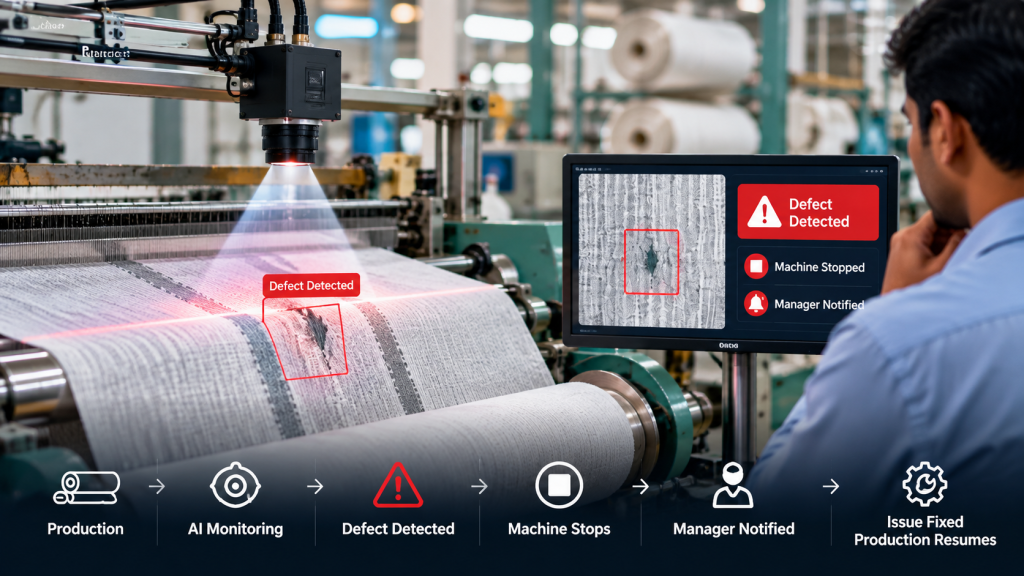
A leading textile fabric manufacturer in Surat was facing a costly production challenge: a small machine error could go undetected long enough to compromise an entire lot of fabric. To address this, we partnered with a machine-retrofitting company from Chandigarh to bring AI-powered computer vision directly onto the production floor. By combining high-FPS cameras with real-time AI analysis, the solution could detect production abnormalities in approximately 20 seconds, stop the machine, and alert the manager for corrective action. The result was a 70%+ reduction in production waste and more than ₹3 crore in annual production losses prevented.
The Challenge: When a Small Production Error Becomes a Crore-Rupee Problem
For a leading textile fabric manufacturer in Surat, India, maintaining consistent quality across production was more than a quality-control challenge—it was a significant financial priority.
In textile manufacturing, a machine calibration issue or production abnormality can continue unnoticed while the machine keeps running. By the time the problem is identified, a substantial quantity of fabric may already have been produced.
In some cases, an entire production lot could be compromised.
The client’s existing process depended heavily on operators and managers to identify production issues. While experienced personnel could spot many abnormalities, there was an inherent limitation: humans cannot continuously inspect every meter of fabric at production speed.
The client needed a way to continuously monitor production and identify problems as close to the moment they occurred as possible.
The objective was simple:
Detect the problem early. Stop production. Give the manager enough information to make the right intervention.
The Solution: Bringing AI-Powered Vision to Existing Machinery
Rather than replacing the client’s existing textile machinery, we partnered with a specialized machine-retrofitting company from Chandigarh to add an intelligent monitoring layer to the production environment.
The existing machines were retrofitted with high-FPS industrial cameras, positioned to continuously capture the fabric as it was being produced.
These camera feeds became the visual input for our AI models.
Our computer vision system analyzed the incoming footage in real time, looking for predefined production abnormalities and fabric-quality issues.
When the AI detected a potential error, the system could automatically stop the production process and notify the responsible manager.
The final production decision, however, remained with the production manager.
The manager could inspect the issue and decide whether to:
- Continue production.
- Stop and inspect the machine.
- Change the machine’s calibration.
- Correct the production issue.
- Restart the machine after the correction.
This created a human-in-the-loop AI system where artificial intelligence handled continuous monitoring while experienced production managers retained control over the final decision.
How the AI-Powered System Worked
1. High-FPS Cameras Captured Production in Real Time
Industrial high-FPS cameras were integrated into the client’s existing production machinery through the retrofitting process.
The cameras continuously captured the fabric surface as it moved through production.
2. AI Models Analyzed the Visual Data
The camera feeds were processed by our AI-powered computer vision models.
Instead of waiting for a batch to be completed and inspected, the system continuously analyzed production while it was happening.
3. Production Abnormalities Were Detected
When the AI identified a visual pattern associated with a production error, it generated an alert.
The system was designed to identify issues early enough to prevent a small production problem from becoming a large-scale material loss.
4. Production Could Be Stopped Automatically
When an anomaly crossed the configured detection threshold, the system could trigger the machine to stop.
This prevented the machine from continuing to produce potentially defective fabric while the issue was investigated.
5. The Manager Was Immediately Notified
The relevant manager received a notification that an abnormality had been detected.
Instead of discovering the problem later through inspection, the production team could intervene while the issue was still localized.
6. Humans Remained in Control
AI did not replace the production manager.
The system provided the detection and intervention mechanism, while the manager made the final operational decision.
This ensured that production expertise and contextual judgment remained part of the process.
From Reactive Inspection to Real-Time Intervention
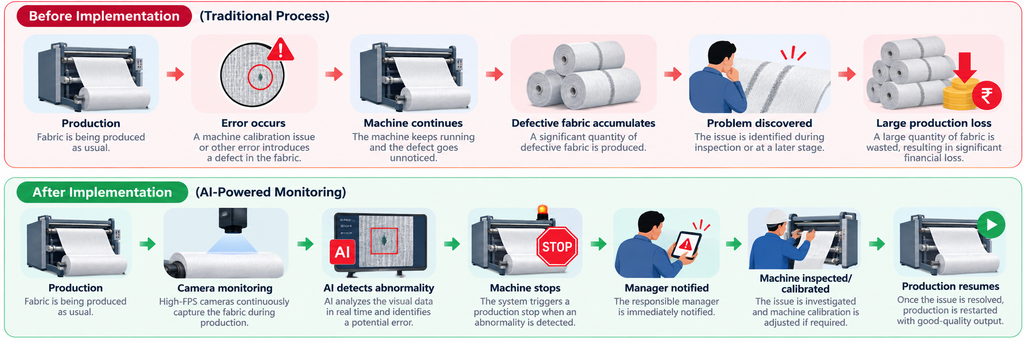
The difference was significant.
“The AI system could detect a production abnormality in approximately 20 seconds, enabling the production team to intervene before the issue could escalate into a substantially larger loss.
The Results: Turning AI Into Measurable Business Value
The implementation delivered a direct impact on production waste and financial losses.
₹3+ Crore
Annual production losses prevented
70%+
Reduction in production waste
20 Seconds
Approximate detection time
By identifying production abnormalities earlier and preventing machines from continuing to produce defective fabric, the solution helped the client avoid more than ₹3 crore in recurring annual production losses.
Early detection and machine intervention significantly reduced the amount of defective fabric produced after a production issue occurred, resulting in a 70%+ reduction in production waste.
The AI-powered system could identify a production abnormality in approximately 20 seconds, allowing the production team to intervene before the issue could escalate into a substantially larger loss.
Continuous production monitoring
The computer vision system continuously monitored the production process while the machines were operating, providing an additional layer of quality control throughout the manufacturing cycle.
Retrofitting Instead of Replacing
One of the important aspects of the project was that the client did not need to replace its existing production machinery.
The solution was built around retrofitting the machines with intelligent visual monitoring capabilities.
This allowed the manufacturer to combine its existing industrial infrastructure with modern AI capabilities.
The approach provided a practical path toward intelligent manufacturing without requiring the disruption and capital expenditure associated with replacing the production equipment.
The Technology Behind the Solution
The project brought together hardware, AI and manufacturing automation into a single production workflow.
Hardware
- High-FPS industrial cameras
- Existing textile production machinery
- Retrofitted camera infrastructure
- Machine-control integration
AI & Computer Vision
- Real-time image processing
- Computer vision
- AI-based anomaly detection
- Production-quality monitoring
Automation
- Automated production-stop triggers
- Real-time alerts
- Manager notifications
- Human-in-the-loop intervention
The combination enabled the AI system to operate as an always-on visual layer over the manufacturing process.
The Bigger Impact
The project demonstrates that AI adoption in manufacturing does not necessarily require a factory to be rebuilt from the ground up.
By combining machine retrofitting, high-speed cameras, computer vision and human decision-making, traditional manufacturing equipment can gain an entirely new layer of intelligence.
The AI effectively became an additional set of eyes on the production floor—one that could continuously monitor the process and alert the team when something went wrong.
But the goal was never to remove humans from the process.
The goal was to give them better visibility.
The machines produced. The cameras watched. The AI detected. The managers decided.
Business Impact
The value of the solution went beyond defect detection. It changed the economics of quality control by moving intervention closer to the point where a production issue occurred.
Instead of allowing a machine problem to generate an increasingly large quantity of defective fabric, the system gave the production team an opportunity to intervene early—limiting material exposure and reducing the financial impact of production errors.
The retrofit approach also meant the client could introduce AI-powered quality control without replacing its existing manufacturing machinery. This allowed the business to build new intelligence around its existing production infrastructure rather than undertaking a costly equipment replacement program.
Most importantly, the system created a scalable model for intelligent manufacturing:
Continuous monitoring → Early detection → Immediate intervention → Lower loss
AI became an additional layer of operational intelligence on the production floor, while experienced managers continued to make the final production decisions.
