

For the last two years, the AI industry has been engaged in a massive, collective delusion.
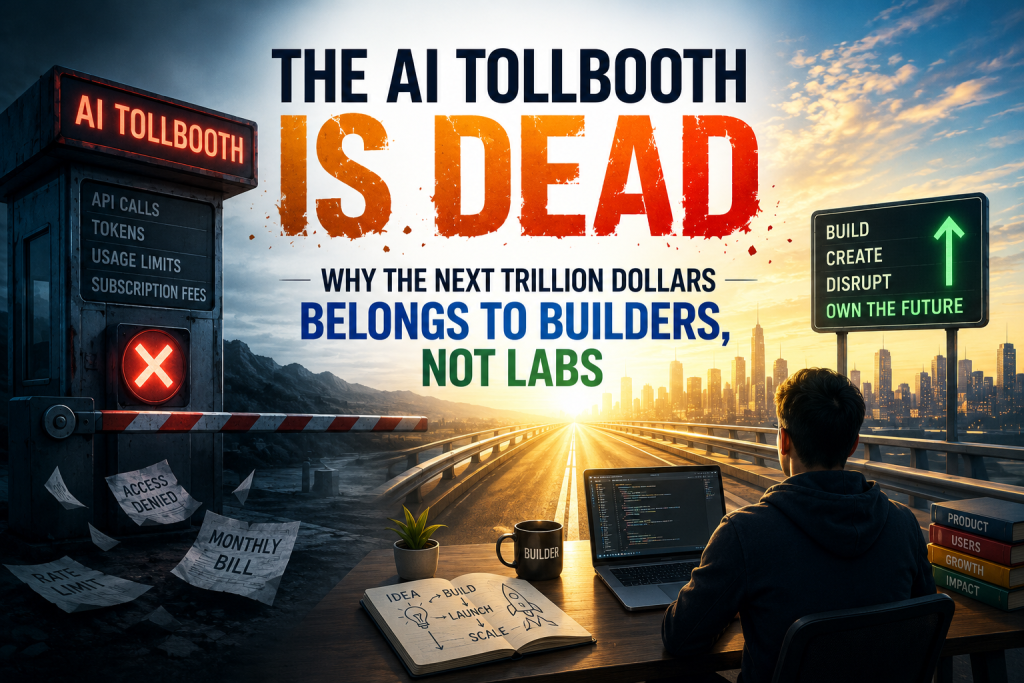
We’ve convinced ourselves that a handful of closed labs—OpenAI, Anthropic, Google—are the sole gatekeepers of the future. They’ve set up tollbooths on the information superhighway, charging exorbitant API rents for access to their proprietary “brains.” They throttle rates, hike prices, and nerf capabilities at the whim of executive safety boards.
But the math is catching up to the marketing. Frontier AI models are rapidly commoditizing. The era of closed labs extracting rent for intelligence is ending. Open-weight models like DeepSeek, Kimi K3, and Llama are turning frontier intelligence into a free, borderless utility.
Here is the reality check for founders, developers, and tech investors: The next trillion dollars in AI won’t be made at the model layer. It will be made at the application layer by builders who focus on distribution, data sovereignty, and relentless execution.
The Fall of the Tollbooth
The closed labs tried to build an unassailable moat by selling access to the smartest brain on earth. It was a great racket while it lasted. You pay per token, and in exchange, you get to borrow their intelligence.
But intelligence is becoming a utility, not a luxury good.
No serious enterprise wants to build critical infrastructure on a rented API. Why? Because the CEO of the lab can wake up one morning, decide your use case violates a newly invented safety guideline, and instantly nerf your model’s capability. Or worse, they hike the price, throttle your rate limits to a crawl, or pivot their strategy and leave your product roadmap in the dust.
You don’t rent your database. You don’t rent your core IP. Why on earth are you renting your intelligence?
Building a business on a closed API is building a house on land you don’t own, where the landlord can change the locks whenever they feel like it. The tollbooth is collapsing under its own weight.
Open Weights are Sovereign Infrastructure
Builders and enterprises need one thing above all else: reliability. They need to know their system will work tomorrow exactly as it does today.
Enter open-weight models.
When you download DeepSeek or Kimi K3, you aren’t subscribing to a service. You are downloading a file. The frontier is no longer a subscription; it’s a file.
Open weights give businesses sovereign control over their infrastructure, delivering things closed APIs never can:
- Cost Certainty: Compute gets cheaper by the day. Once you have the weights, the economics are entirely in your hands. No surprise price hikes.
- Data Privacy: Your proprietary data never leaves your servers. You aren’t feeding your hard-earned context back into the very labs that might compete with you tomorrow.
- Absolute Control: No throttling. No ideological guardrails. No sudden deprecations. You own the weights, you own the behavior.
The Rise of the Sovereign AI Enterprise
This is where the real paradigm shifts. Open weights don’t just save money; they unlock entirely new architectures of control.
If you are a Fortune 500 bank, a massive healthcare network, or a defense contractor, sending raw customer data through an OpenAI API is a non-starter. Compliance, liability, and IP protection forbid it. But with open weights, these massive enterprises can download a frontier model, host it on an air-gapped, internal GPU cluster, and create a completely secure, customized version of their own.
They can fine-tune it on decades of private corporate data without a single byte ever touching the public internet. The model becomes an internal asset, not an external vendor dependency.
And it’s not just enterprises. Entire nations are waking up to this. Governments realize that relying on American or Chinese API providers for critical infrastructure is a geopolitical liability. Open weights allow countries to build “Sovereign AI”—downloading the files, hosting them on domestic infrastructure, and ensuring their economic future isn’t dictated by a foreign API quota.
The Futility of Regulation and the Illusion of AI Hoarding
While the labs play defense, governments are playing offense. Both the US and Chinese governments are scrambling to ban, restrict, or hoard AI models and the chips that run them out of a toxic mix of fear and national pride.
It is a complete fool’s errand.
You cannot regulate math. You cannot embargo an algorithm. Open-source inherently routes around censorship and export controls. When a frontier-level model is dropped on HuggingFace, it doesn’t matter what the State Department or the CCP says—the weights are instantly replicated across thousands of servers globally.
Protectionism is the strategy of the defeated. Bureaucrats think innovation is a physical good you can stack in a warehouse and tariff at the border. They believe that if they restrict compute and ban model exports, they can contain the spread of intelligence.
They are fundamentally misunderstanding the physics of software. If the US tries to restrict access to frontier models, a sovereign nation simply downloads an open-weight equivalent, spins it up on domestic compute, and builds their own secure version. You can’t put a DRM lock on a mathematical formula. The market doesn’t care about borders; the market always routes to capability. The harder governments try to hoard AI, the faster the open-source community will route around them.
The New Moat: When the Brain is Free
So, what happens when everyone has access to the exact same free, frontier-level intelligence?
The model ceases to be the differentiator. The moat shifts entirely to the things AI cannot generate for you. When the brain is a free utility, the value moves to how you apply it. The new moats are:
- Distribution: Who owns the audience? If you have the eyeballs, you can plug in any model you want underneath. He who owns the route to market wins. Distribution is the ultimate kingmaker when the underlying tech is commoditized.
- Product Taste: Who actually understands the customer’s pain? AI can write code, but it can’t empathize with a frustrated procurement manager. Taste is the ultimate filter for relevance. The companies that win will be the ones who design workflows that humans actually want to use, not just impressive tech demos.
- Execution Speed: Who ships fastest? The era of 18-month release cycles is dead. He who ships the ugly MVP today beats the polished enterprise demo next quarter. Open weights allow you to iterate behind closed doors without begging an API provider for higher rate limits.
- Proprietary Data: Who has the unique context? When everyone has the same base model, the winner is the one who fine-tunes the weights on data nobody else has access to. Your messy, proprietary, domain-specific data becomes the rocket fuel that turns a generic open model into a domain expert.
This value-chain shift isn’t a future prediction—it’s already happening. Look at the landscape today versus 18 months ago:
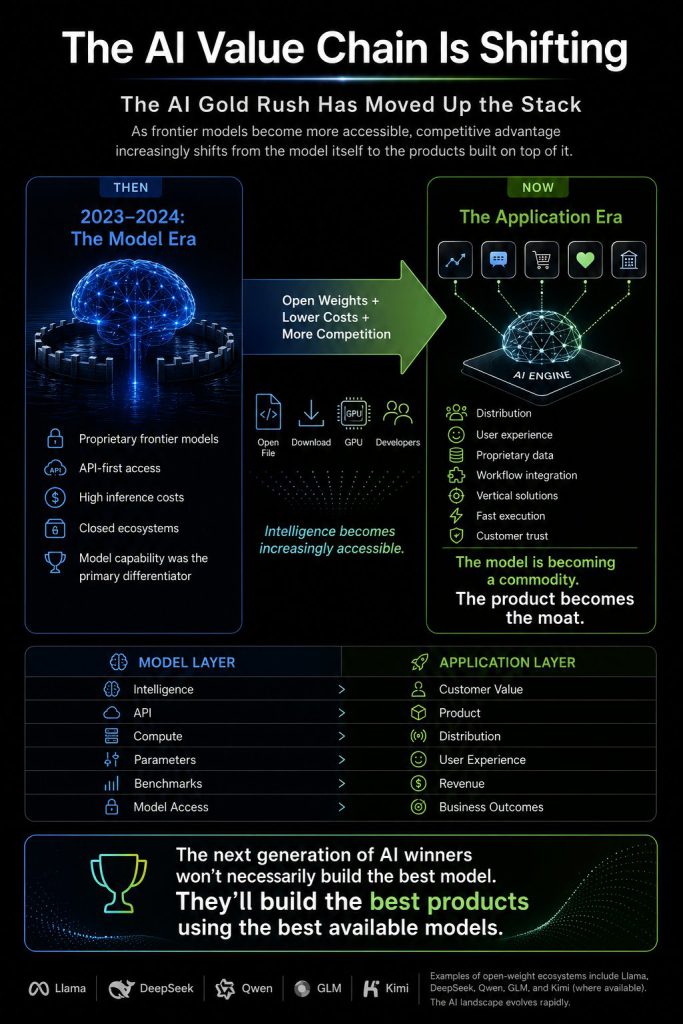
The transition is clear: Open weights, lower costs, and hyper-competition have commoditized the model layer. The next generation of AI winners will use existing models to build the best products. The model is the commodity; the product is the moat.
The Application Layer Trillion-Dollar Opportunity
This brings us to the money. The real wealth in the next decade won’t come from building AGI. It will come from “plain wrapper” apps.
For two years, the tech elite have mocked “GPT wrappers.” They are blind. The most profitable software companies of the next decade will be exactly that: incredibly thin wrappers around open-source models that solve hyper-specific, boring, high-ticket B2B problems.
Think logistics routing for mid-tier freight companies. Think automated compliance auditing for regional banks. Think dental billing reconciliation.
Nobody cares if your app uses a 700B parameter model or a fine-tuned 8B model running on a localized GPU cluster. They care if it saves them $200,000 a year in administrative overhead.
The trillion-dollar opportunity isn’t in selling the brain. It’s in hardwiring the brain into the boring, unglamorous plumbing of the global economy. The closed labs burned billions training the model. You get to use it for free to solve a problem a customer is willing to pay millions to fix. The margins in the application layer, powered by free intelligence, will be astronomical.
Stop Watching the Benchmarks
The frontier is commoditized. Intelligence is free. The tollbooth is gone.
If you are a founder, developer, or investor, stop obsessing over model benchmarks. Stop waiting for GPT-5 to magically solve your product problems. Stop paying rent to closed labs that view you as a liability.
Download the weights. Stand up the infrastructure. Secure your data. Take your plain wrapper to market.
The model is not the product. The distribution is. The execution is. Go build.
